A company specialising in the production of chart paper needed to automate its end-of-line packaging process. The goal was to create a protective wrapper that reduced exposure to dust, moisture and handling during transport and storage.
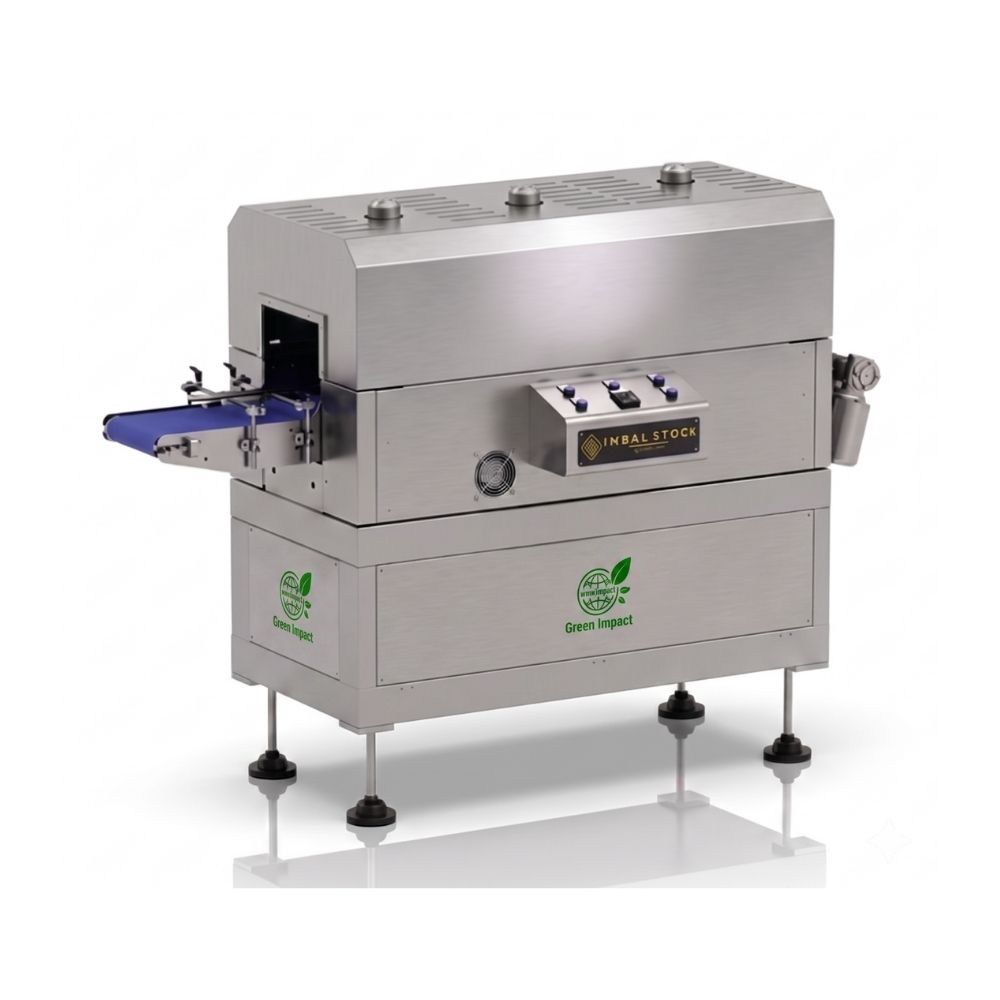
The proposed line combines the IS-600-CONCEPT shrink wrapper with the three-chamber IMB 2528 Green Impact shrink tunnel.
The shrink wrapper feeds centerfold polyolefin film using rubber-coated wheels and a servo-controlled dancer arm. Continuous longitudinal sealing and pneumatic transverse sealing form the pack around the product, while excess film is rewound automatically by a dedicated reel controlled by proximity sensors.
After sealing, the product enters the IMB 2528 tunnel. Belt speed, temperature and airflow are adjusted to the sample, while controlled ventilated heat shrinks the film around the pack.
A 15-micron polyolefin film was specified for this application. The thickness and operating parameters cannot be applied automatically to other products: temperature, speed and pack quality must be confirmed through practical machinability tests using actual chart paper samples.
The machine accepts centerfold film reels up to 750 mm wide and 350 mm in diameter. These values describe reel handling on the shrink wrapper, not the maximum product dimensions inside the tunnel.
The final pack depends on the coordination of product, film, sealing and shrinking. The assessment therefore covers the film behaviour on the shrink wrapper, product stability during transport and the settings of the thermal process, rather than the tunnel alone.